Launch offer — valid today only

📄 Digital book in PDF · read it on your phone or print it

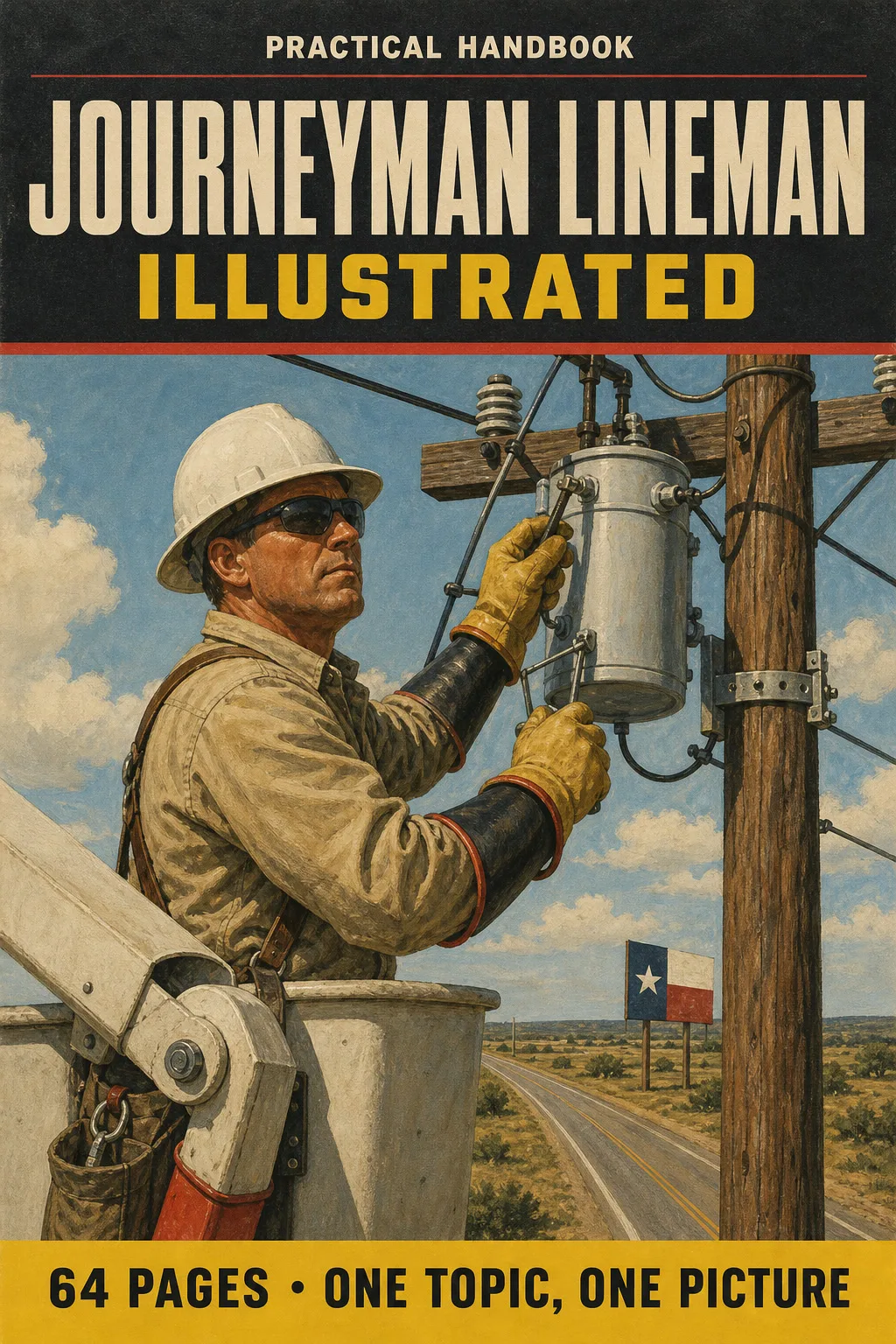
The Journeyman Lineman Exam in Drawings: See Every Bank, Clearance and Formula One Topic on Every Page

The whole grid, lineman math, transformer banks, pole framing, fuse cutouts, URD cable, approach distances, rubber goods and switching. Every topic gets its own page: the drawing first, then what you need to remember. 64 illustrated pages.

YES, I WANT THE ILLUSTRATED BOOK

🔒 Secure checkout · PDF by email · 30-day guarantee

Every topic, its own pageEvery bank, clearance and procedure drawn, with the explanation right beside it
64 illustrated pages8 parts, from the whole grid to the pre-exam checklist
Up-to-date sourcesNESC (IEEE C2-2023), OSHA 29 CFR 1910.269, 1910.333 and 1926 Subpart V
PDF by emailFormat

Look Inside the Book

Every page has one big drawing and a box with the numbers, ratios and steps you need to know:

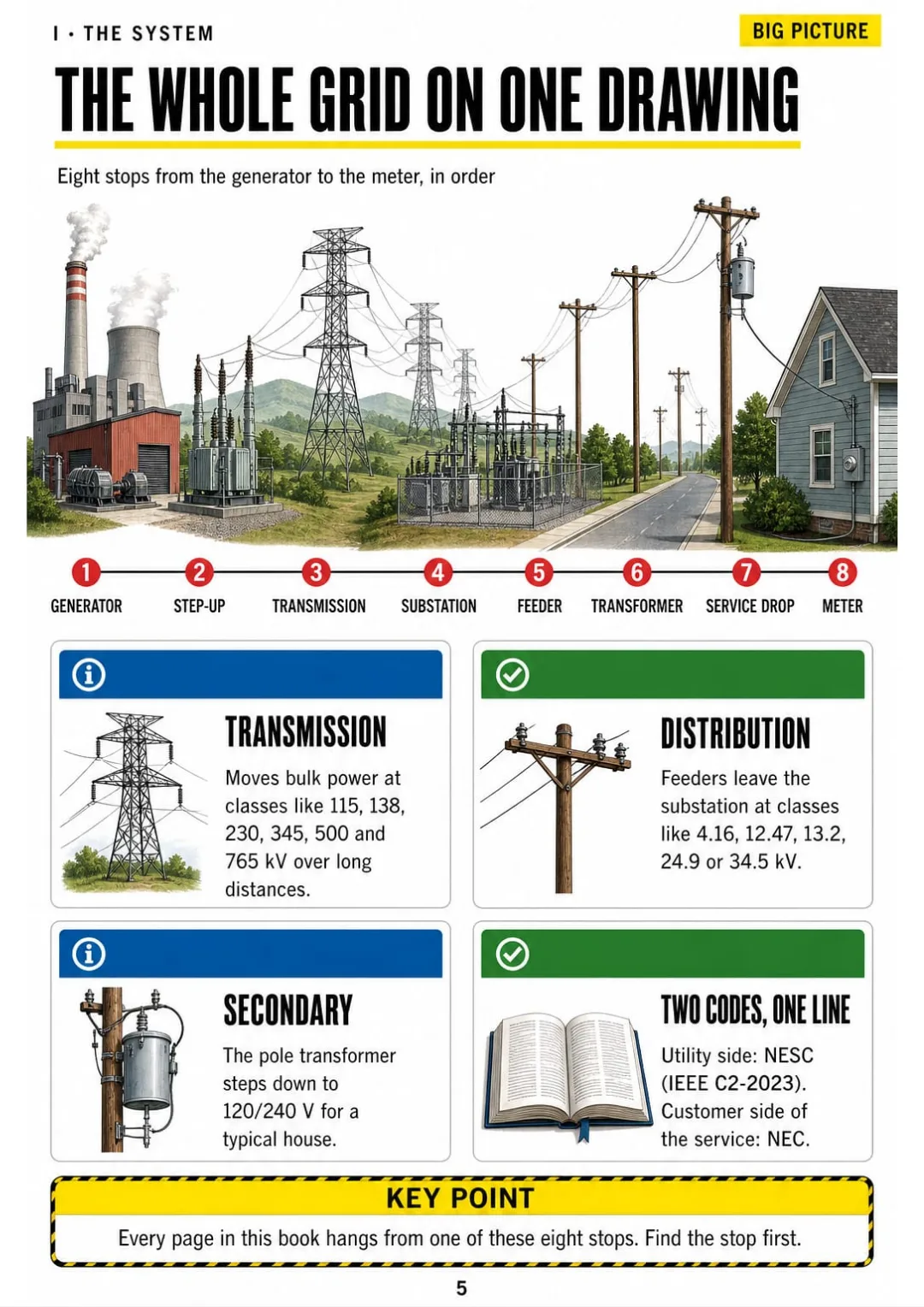
Generator → step-up → transmission → substation → feeder → transformer → service drop → meter
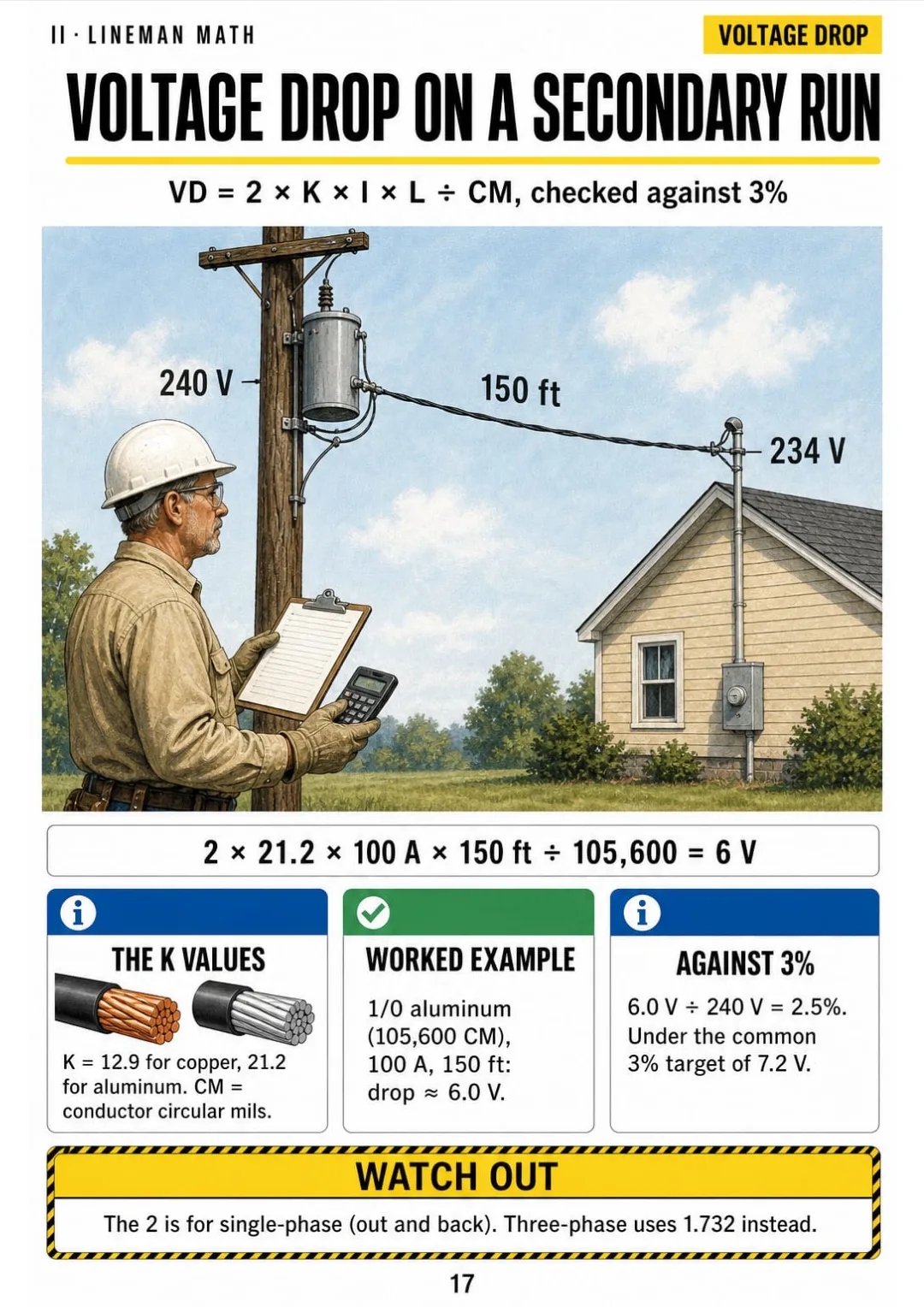
1/0 aluminum, 100 A, 150 ft: 6 V drop, 2.5% on 240 V
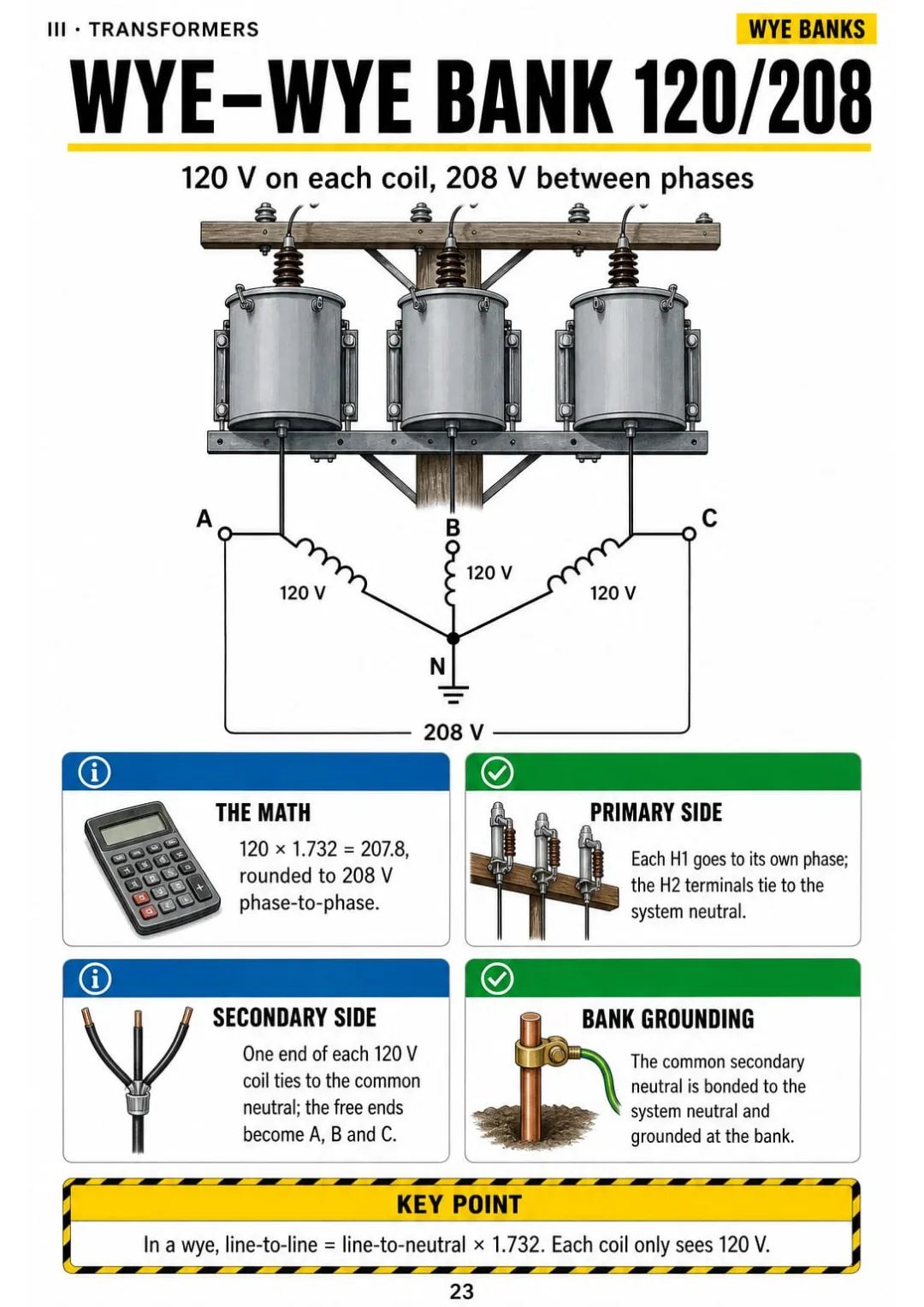
Wye–wye 120/208: 120 V per coil × 1.732 = 208 V phase-to-phase, common neutral grounded at the bank.
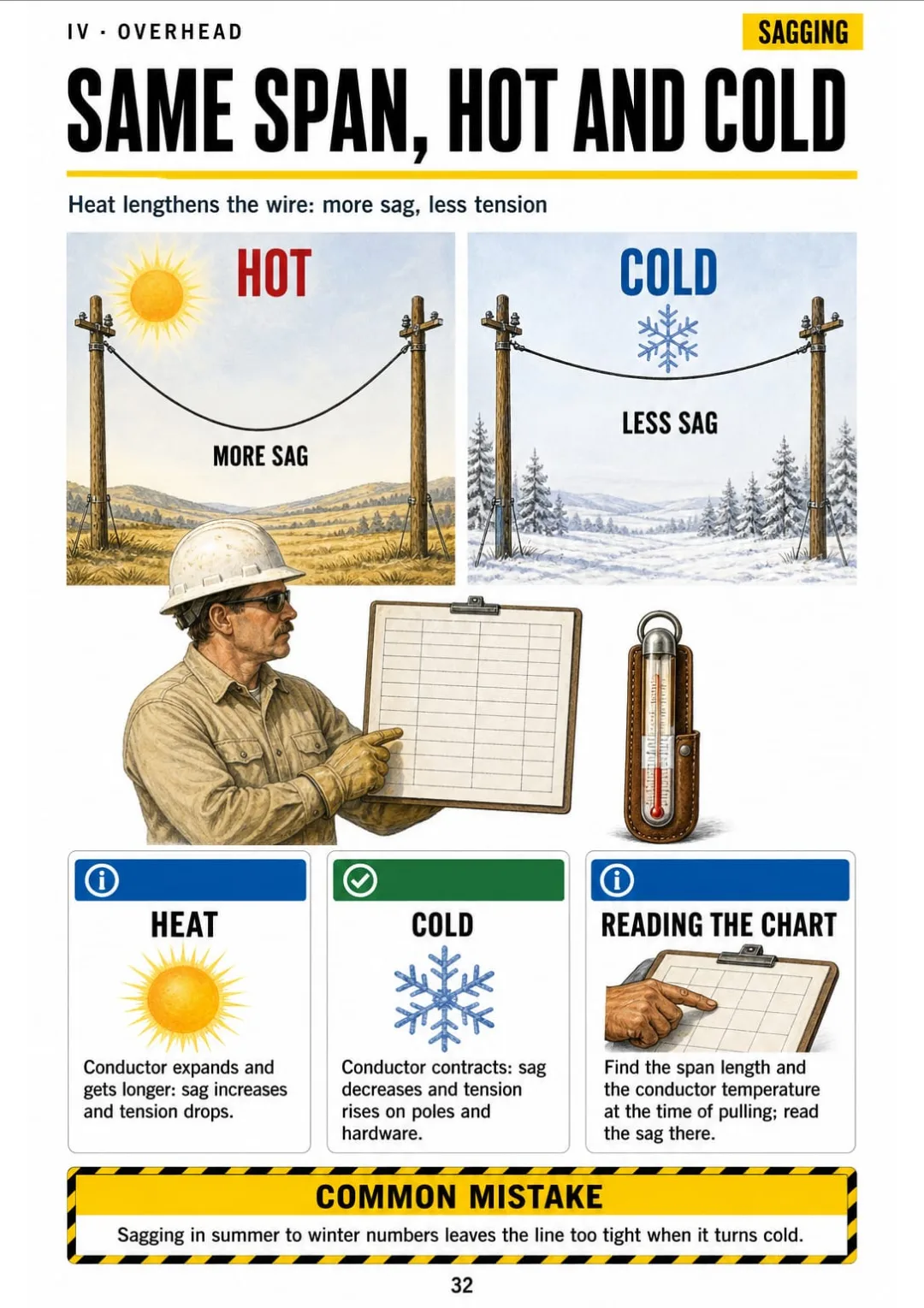
Hot span sags more, cold span pulls tighter · sag charts read by span and temperature
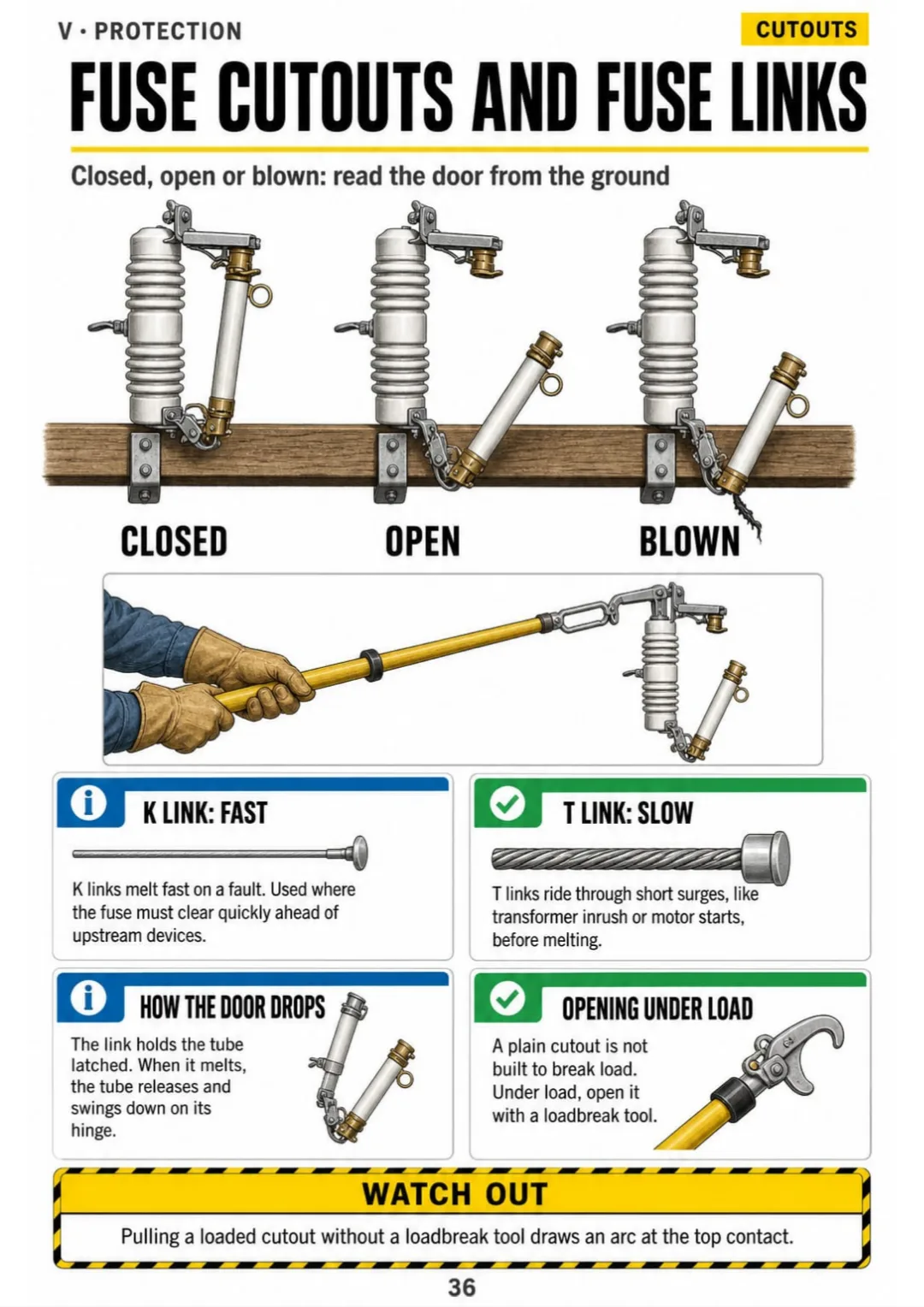
Cutout closed, open and blown · K fast vs. T slow · loadbreak tool under load
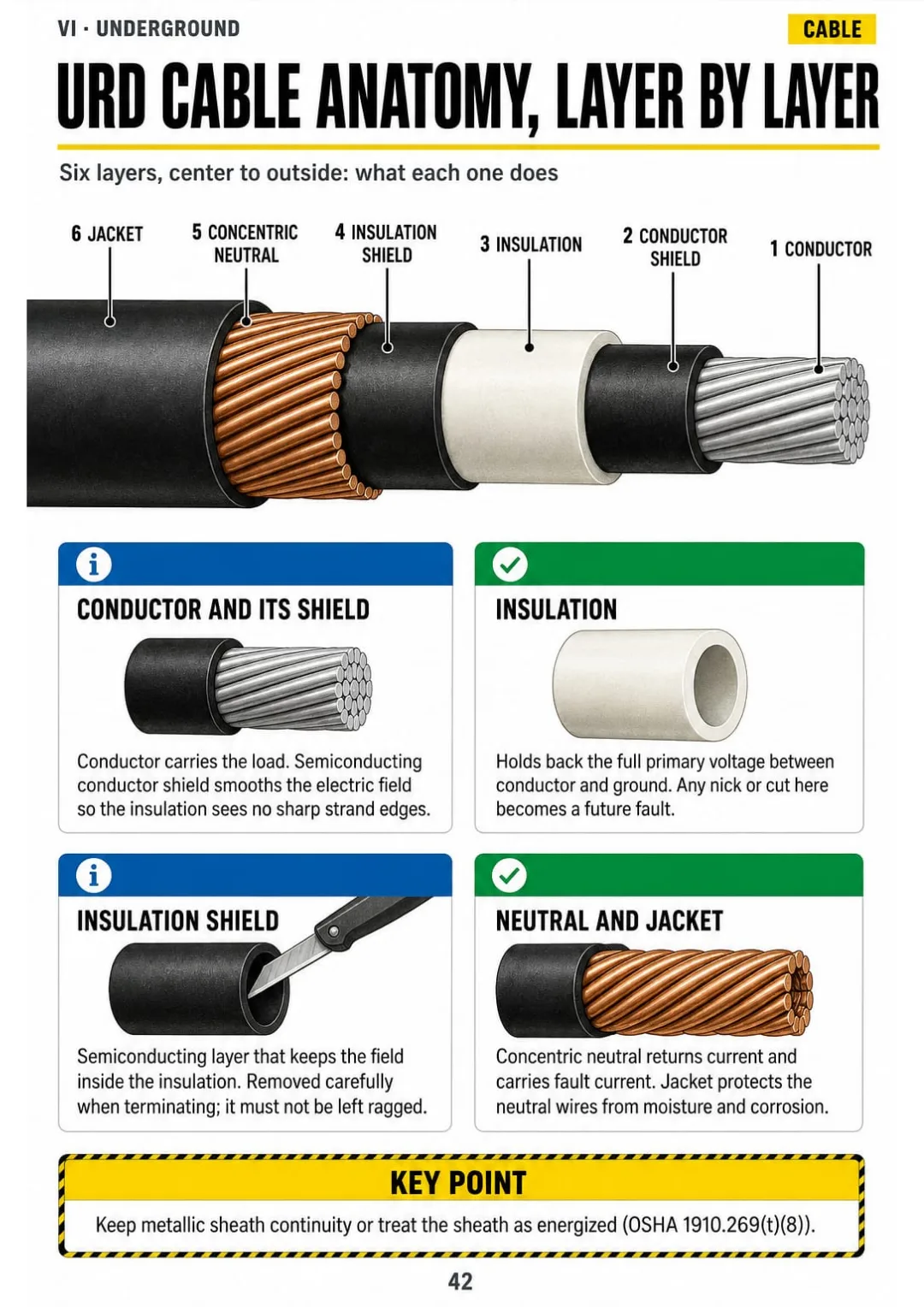
Conductor, shield, insulation, shield, concentric neutral, jacket: one cutaway, six jobs.
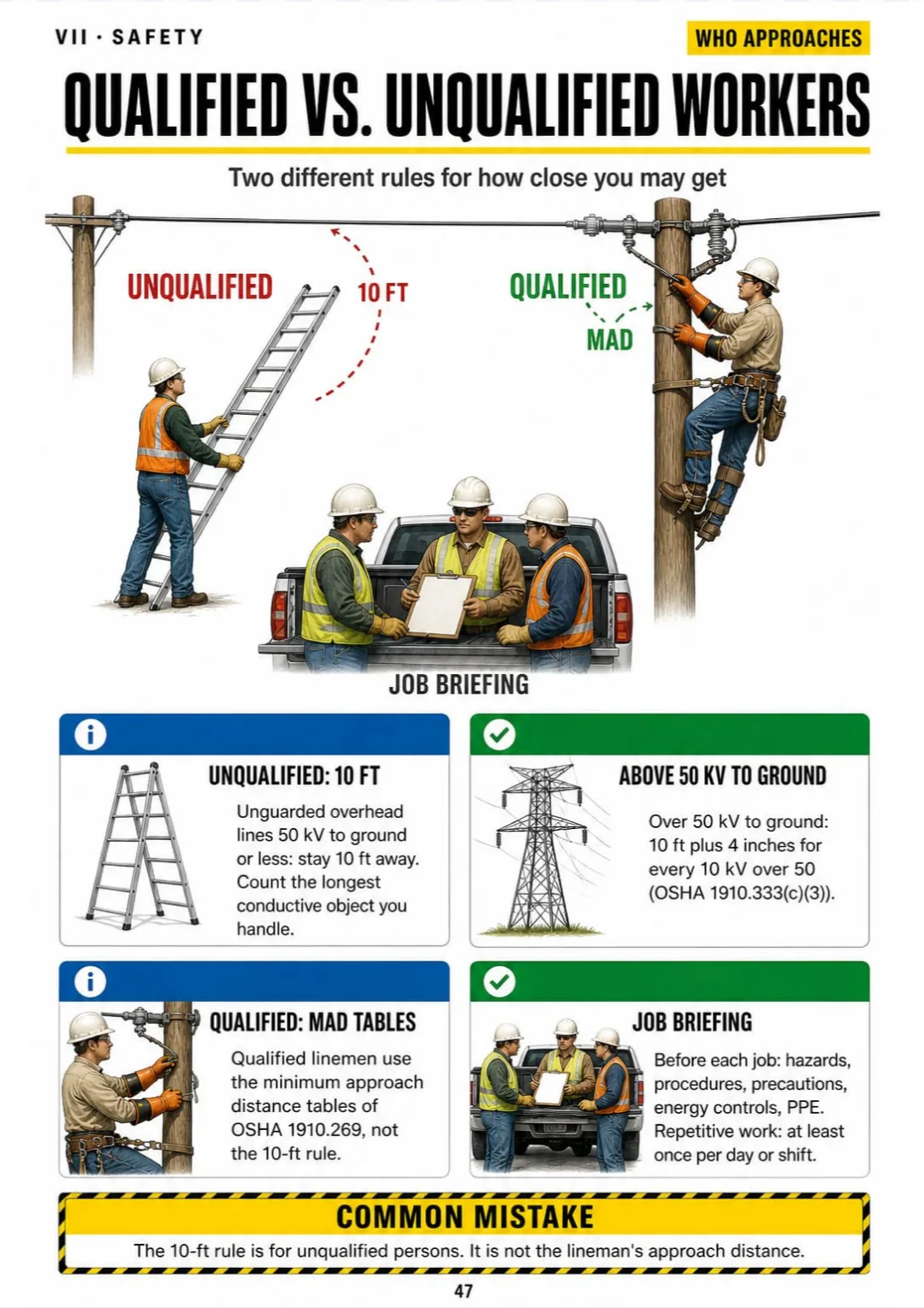
Unqualified: 10 ft up to 50 kV to ground, plus 4 in per 10 kV above. Qualified: OSHA MAD tables.
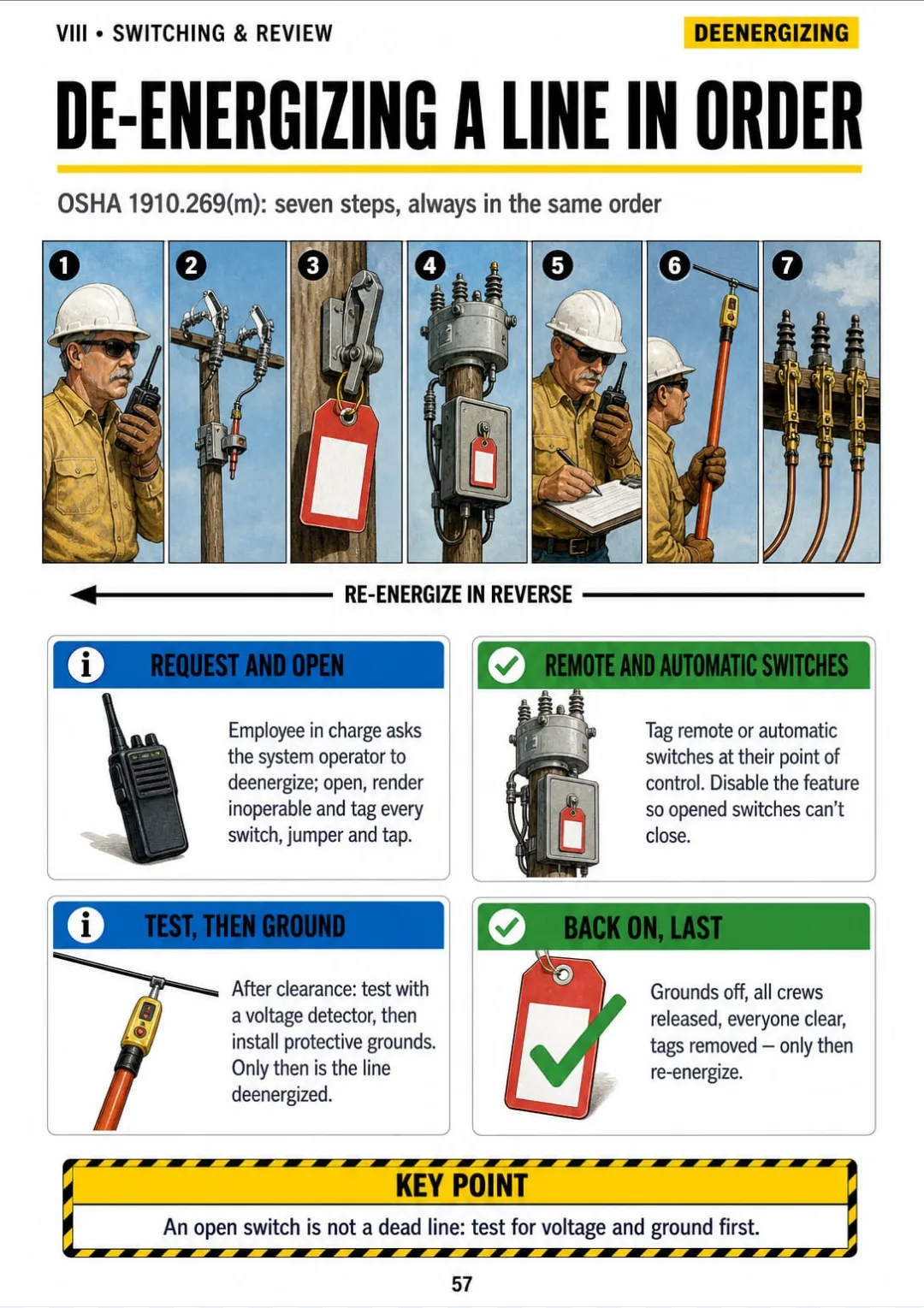
Request, open, tag, disable remote/automatic closing, test, ground — then it's deenergized (OSHA 1910.269(m)).

Swipe to see more →

These are real pages from the book. The table of contents is the full one: 8 parts and 60 topics.

The Problem Isn't You. It's How They Explained It.

You're on a practice question: three single-phase cans, primaries in wye, secondaries in delta. What's phase-to-phase on the secondary, and where does the 30° shift come in? You've built banks like this, and on paper the answer still won't come.

The manual covers it in three paragraphs on flux, windings and turns ratio, with no picture of what's inside the tank. Words alone don't show you where H1 ends and X2 begins.

Wye–wye 120/208: 120 V per coil × 1.732 = 208 V phase-to-phase, common neutral grounded at the bank.

Here that bank is one drawing: three cans, each H1 and H2 marked, the secondaries closed in delta, the voltage written on every leg and the 30° shift drawn right on the phasors.

Same with the single can and its 30:1 turns ratio, the nameplate, additive vs. subtractive polarity, the 120/208 wye–wye bank, the high leg on a delta and open-delta: each one has its own page and its own drawing.

You see it, it makes sense, and you work the question without going back to the manual.

COMPARE FOR YOURSELF

Same Topic, Two Ways to Study It

THIS
  • The manual: line after line after line
  • Ohm's law and circuits explained only in words
  • You walk into the exam still unsure
In a four-wire delta secondary, one of the three transformers is center-tapped and its midpoint grounded, providing 120/240 V single-phase service from that winding. The phase conductor connected at the junction of the two remaining windings, commonly designated the high leg or wild leg, exhibits a potential to ground equal to the line-to-line voltage multiplied by the square root of three divided by two, approximately 208 V on a 240 V system, and consequently must be identified with orange marking and must not be used to supply 120 V loads.
FOR THIS
  • The delta bank on one drawing, high leg in orange
  • 120, 120 and 208 V to ground, written on each leg
  • You see it and it makes sense
1/0 aluminum, 100 A, 150 ft: 6 V drop, 2.5% on 240 V
CONTENTS

Take a Look at the 8 Parts and 60 Topics

The system as one path, lineman math, transformers and banks, overhead construction, protection, underground, safety and grounding, then switching, rescue and review: 64 pages, all illustrated.

IThe System as One Path · pp. 5-10
  1. The Whole Grid on One Drawing
  2. Voltage Classes in the Field
  3. Inside the Distribution Substation
  4. Phase-to-Phase vs. Phase-to-Ground
  5. The Neutral and Why It's Grounded
  6. Reading a Distribution Pole Top to Bottom
IILineman Math with Worked Examples · pp. 11-18
  1. Ohm's Law on One Triangle
  2. Power: Watts, VA and Power Factor
  3. Three-Phase Power and the 1.732
  4. Transformer Full-Load Current
  5. Turns Ratio in Both Directions
  6. Series and Parallel Circuits
  7. Voltage Drop on a Secondary Run
  8. Guy Tension and Pole Angles
IIITransformers and Banks · pp. 19-27
  1. How a Distribution Transformer Works
  2. Reading the Nameplate
  3. Additive vs. Subtractive Polarity
  4. Single-Phase 120/240 Split Secondary
  5. Wye–Wye Bank 120/208
  6. Wye–Wye Bank 277/480
  7. Delta Secondary and the High Leg
  8. Open-Delta: Two Cans Doing Three-Phase
  9. Wye–Delta and Delta–Wye: The 30° Shift
IVOverhead Construction · pp. 28-35
  1. Pole Classes, Lengths and Setting Depth
  2. Crossarms, Insulators and Framing
  3. Guys and Anchors
  4. Conductors: AAC, ACSR, Copper
  5. Sag, Tension and Temperature
  6. Splices, Connectors and Dead-Ends
  7. Knots and Rigging for the Handline
  8. Service Drops and the Meter
VProtection and Line Equipment · pp. 36-41
  1. Fuse Cutouts and Fuse Links
  2. Reclosers and Sectionalizers
  3. Lightning Arresters
  4. Capacitor Banks
  5. Voltage Regulators
  6. Disconnect Switches and Load-Break
VIUnderground Distribution · pp. 42-46
  1. URD Cable Anatomy
  2. Pad-Mount Transformers
  3. Elbows and Loadbreak Operation
  4. Risers and Terminations
  5. Fault Locating on Underground
VIISafety: Approach, Rubber Goods and Grounding · pp. 47-56
  1. Qualified vs. Unqualified Workers
  2. Minimum Approach Distances on the Pole
  3. Rubber Glove Classes and Colors
  4. Inspecting and Testing Rubber Goods
  5. Cover-Up: Blankets, Line Hose, Hoods
  6. Hot Sticks and Live-Line Tools
  7. Fall Protection on Poles and in Buckets
  8. Step and Touch Potential
  9. Temporary Protective Grounding
  10. The Equipotential Zone
VIIISwitching, Rescue and Exam Review · pp. 57-64
  1. De-Energizing a Line in Order
  2. Switching Orders and Clearances
  3. Lockout/Tagout vs. Line Clearance
  4. Pole-Top Rescue, Step by Step
  5. Bucket Rescue
  6. Trees, Digger Derricks and Trucks Near Lines
  7. Lineman Exam Formula Sheet
  8. Pre-Exam Checklist

One Page, One Topic, All Clear

Think of it this way:

It's exam day, and the question asks what has to happen, in order, before a line can be treated as deenergized. On the crew you've watched it done a hundred times. On paper, the steps blur.

In the book you open the page on de-energizing a line and see the steps numbered along the drawing: request, open, tag, disable remote and automatic closing, test, ground. Same order every time, with OSHA 1910.269(m) printed beside it.

Cutout closed, open and blown · K fast vs. T slow · loadbreak tool under load

Same with pole setting depth, K and T fuse links, URD cable layer by layer, approach distances for unqualified workers and transformer turns ratio: each one on its own page.

Journeyman Lineman Illustrated is 8 parts and 60 topics, all drawn, and it ends with a lineman formula sheet and a pre-exam checklist.

What you see drawn, you don't have to memorize.

What's Inside Journeyman Lineman Illustrated:

Ipp. 5-10

The System as One Path

The grid from generator to meter on one drawing, voltage classes, the distribution substation, phase-to-phase vs. phase-to-ground, the grounded neutral and a pole read top to bottom.

IIpp. 11-18

Lineman Math with Worked Examples

Ohm's law, watts, VA and power factor, three-phase power and the 1.732, full-load current, turns ratio, series and parallel, voltage drop and guy tension, each with worked examples.

IIIpp. 19-27

Transformers and Banks

How a distribution transformer works, the nameplate, polarity, the 120/240 split secondary, wye–wye banks, the delta high leg, open-delta and the 30° shift. You look at a bank and know what voltage sits on every lead.

IVpp. 28-35

Overhead Construction

Pole classes and setting depth, crossarms and insulators, guys and anchors, conductors, sag and tension, splices and dead-ends, handline rigging and service drops.

Vpp. 36-41

Protection and Line Equipment

Fuse cutouts and links, reclosers and sectionalizers, lightning arresters, capacitor banks, voltage regulators and disconnect switches.

VIpp. 42-46

Underground Distribution

URD cable anatomy, pad-mount transformers, elbows and loadbreak operation, risers and terminations, and fault locating underground.

VIIpp. 47-56

Safety: Approach, Rubber Goods and Grounding

Qualified vs. unqualified workers, minimum approach distances, rubber glove classes, testing rubber goods, cover-up, hot sticks, fall protection, step and touch potential, protective grounding and the equipotential zone. Every distance is a measurement on a drawing, not a number lost in a table.

VIIIpp. 57-64

Switching, Rescue and Exam Review

De-energizing a line in order, switching orders, lockout/tagout vs. line clearance, pole-top and bucket rescue, trucks near lines, the formula sheet and the pre-exam checklist.

At the end of the book: A lineman exam formula sheet and a pre-exam checklist.
Plus: 2 Free Books

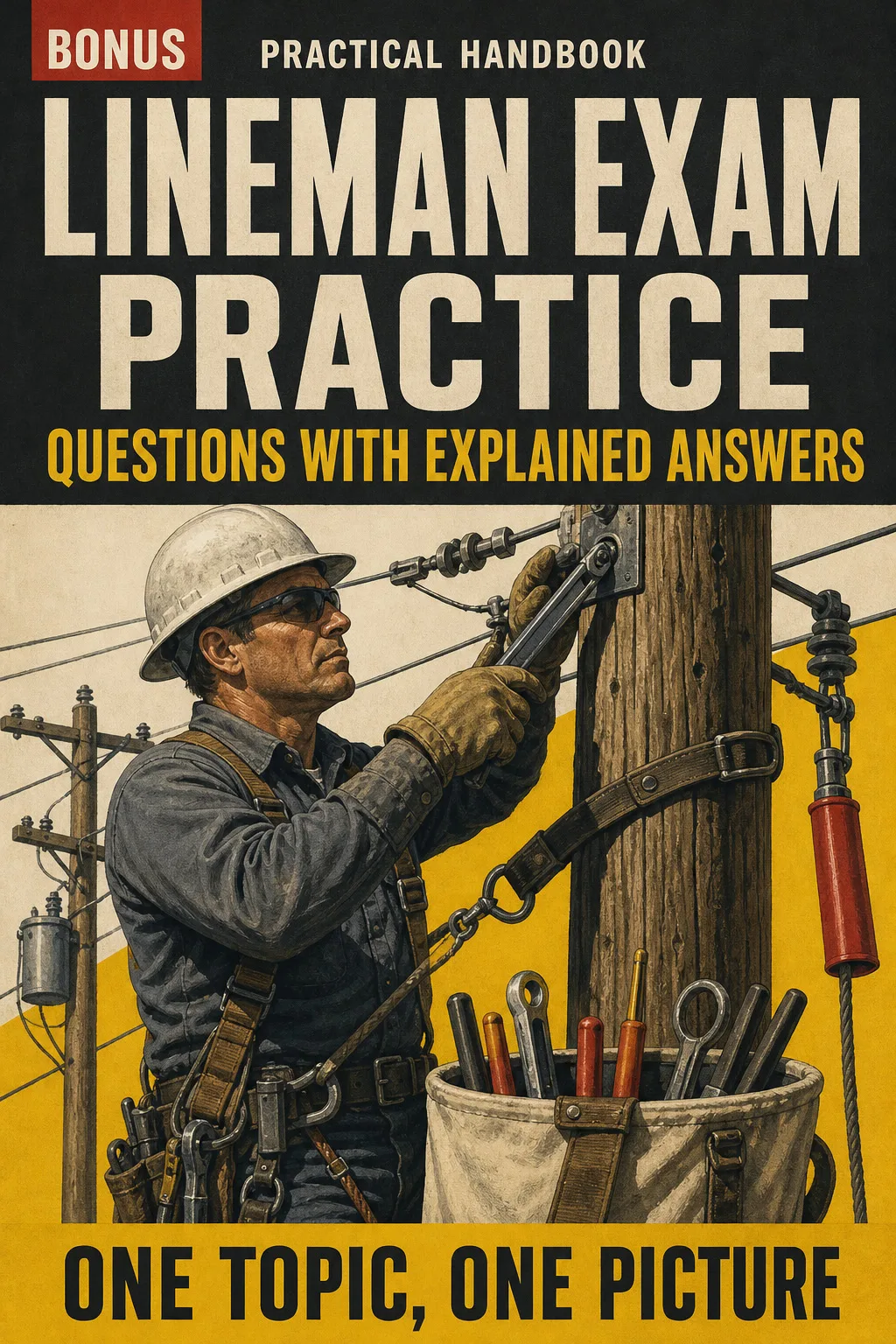
Lineman Exam Practice: Questions with Explained Answers

BONUS 1: «Lineman Exam Practice: Questions with Explained Answers»

Value on its own: US$ 17.90

Test yourself topic by topic with exam-style questions, and see the drawing behind every answer so you know why it's right.

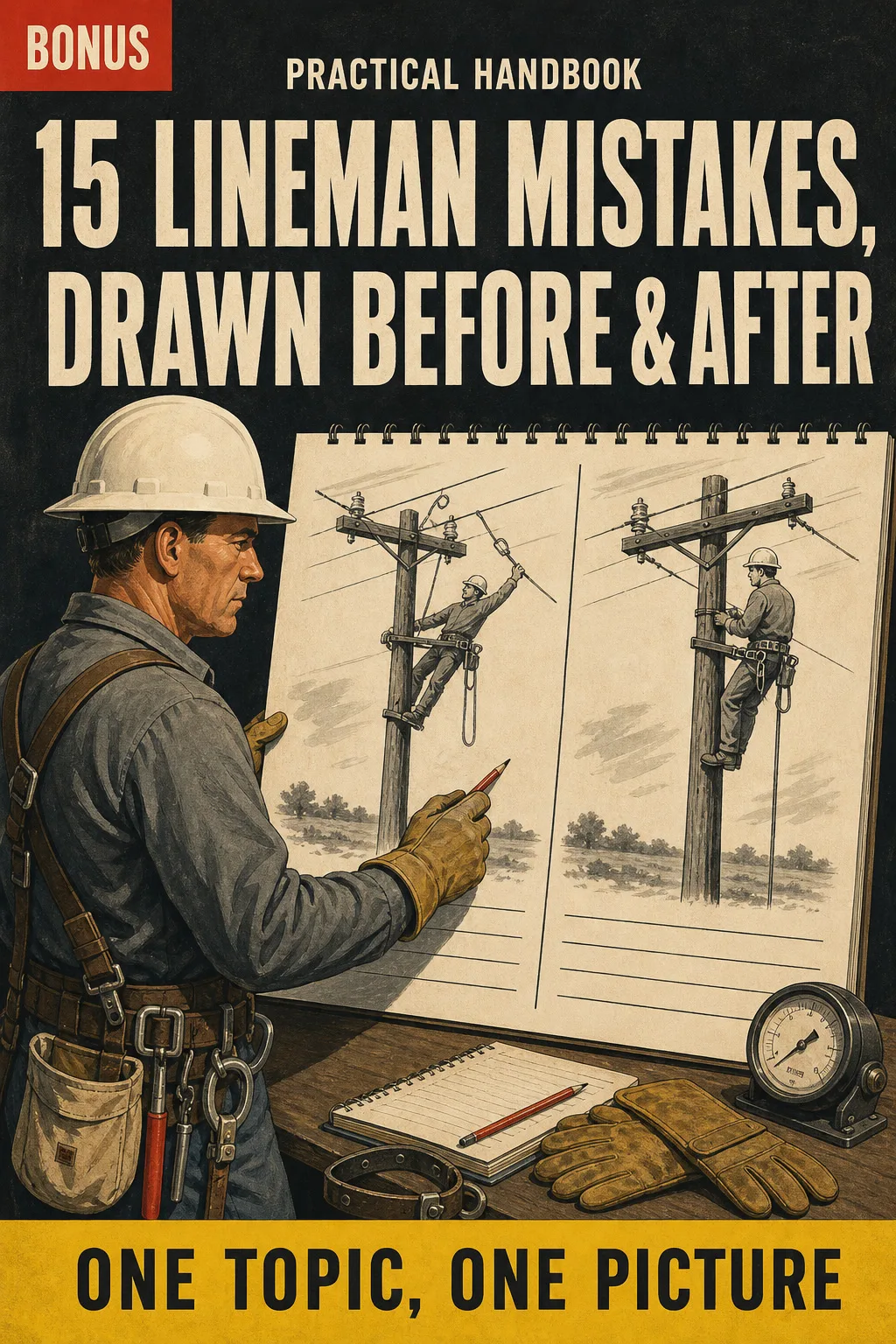
15 Lineman Mistakes, Drawn Before & After

BONUS 2: «15 Lineman Mistakes, Drawn Before & After»

Value on its own: US$ 14.90

The most common mistakes on transformer connections, grounding, clearances and rubber goods, each one drawn wrong and right on a single page.

Journeyman Lineman Illustrated with 2 Free Books

  • Journeyman Lineman Illustrated: 64 illustrated pagesUS$ 63
  • BONUS 1: Lineman Exam Practice: Questions with Explained AnswersUS$ 17.90
  • BONUS 2: 15 Lineman Mistakes, Drawn Before & AfterUS$ 14.90
  • High-resolution PDF to printIncluded
Total value US$ 95.80
YOUR PRICE:
US$ 27
You save US$ 68.80
YES, I WANT JOURNEYMAN LINEMAN ILLUSTRATED FOR US$ 27

📄 This is a digital PDF book sent to your email: nothing is printed or shipped.

Secure purchaseEncrypted payment30-day guarantee

PDF by email: We email you Journeyman Lineman Illustrated as a PDF, together with the two free books. It's a single payment: no installments, no extra charges.

Who This Book Is For

You're an apprentice working toward topping out

You're an apprentice working toward topping out

The theory behind what you do on the pole, laid out in one order, so every night of study builds on the last one.

Your journeyman exam is coming up

Your journeyman exam is coming up

Transformer banks, lineman math and approach distances on one page each, plus practice questions with the drawing behind every answer.

You're a journeyman changing utilities or states

You're a journeyman changing utilities or states

A quick, printable review of NESC and OSHA 1910.269 topics you studied years ago, to keep in the truck.

Everything You Get Today

US$ 95.80US$ 27
YES, I WANT JOURNEYMAN LINEMAN ILLUSTRATED FOR US$ 27

📄 This is a digital PDF book sent to your email: nothing is printed or shipped.

30DAYS
GUARANTEE

30-Day Guarantee

Try Journeyman Lineman Illustrated for 30 days, bonus books included.

We refund everything if the file won't open, if the book isn't what you see here, if you were charged twice or if the email doesn't arrive. Just email us.

You pay once. No subscriptions.

Frequently Asked Questions

Is it for me if I've been working on lines for years?

Yes. It doesn't treat you like a beginner: it puts what you already do on the pole into the order the exam asks for, with the math and the tables drawn. It's built on the national codes, NESC (IEEE C2-2023) and OSHA 1910.269, which most states and utilities follow. Topping-out exams vary by apprenticeship program and utility, so check your program's study list. Moving to California? Overhead and underground clearances there follow CPUC GO 95 and GO 128, not the NESC: the theory, math, banks and OSHA safety pages still apply, but check clearance values against those orders.

Where does the content come from?

It's checked against the National Electrical Safety Code (IEEE C2-2023), OSHA 29 CFR 1910.269, 29 CFR 1910.333 and 29 CFR 1926 Subpart V. Always confirm values against the current edition and your company's rules.

Is this official material?

No. It's an independent illustrated study book. It isn't published or endorsed by IEEE, OSHA, any apprenticeship program, union or utility, and it doesn't give you a certificate or training hours: your journeyman card comes from your program or employer.

Does it replace my apprenticeship or safety training?

No. It helps you study and review. It doesn't replace your apprenticeship, qualified-worker training, on-the-job instruction or your employer's safety procedures.

Are the practice questions the ones on the exam?

No. They're written for this book, in exam style, to test yourself topic by topic. They aren't official questions from any exam.

When and how do I get it?

As a PDF by email, sent to the address you enter at checkout: the book and the 2 bonus books.

Do I have to pay every month?

No. It's a one-time payment. No subscription.

Can I have it on paper?

Yes. The PDF is made to print: big drawings, large type. Print it at home or at a print shop and keep it in the truck.

How does the refund work?

You have 30 days. We refund everything if the file won't open, if the book isn't what you see on this page, if you were charged twice or if the email doesn't arrive: just email us.

Before You Close This Page

No more rereading without anything sticking.

A transformer bank? You see it drawn and you've got it.

You walk into the exam knowing where everything is.

Drawings make studying faster.

The book is right below.

One-time payment: US$ 27 · Guarantee: 30 days · PDF by email

YES, I WANT JOURNEYMAN LINEMAN ILLUSTRATED FOR US$ 27

📄 This is a digital PDF book sent to your email: nothing is printed or shipped.